

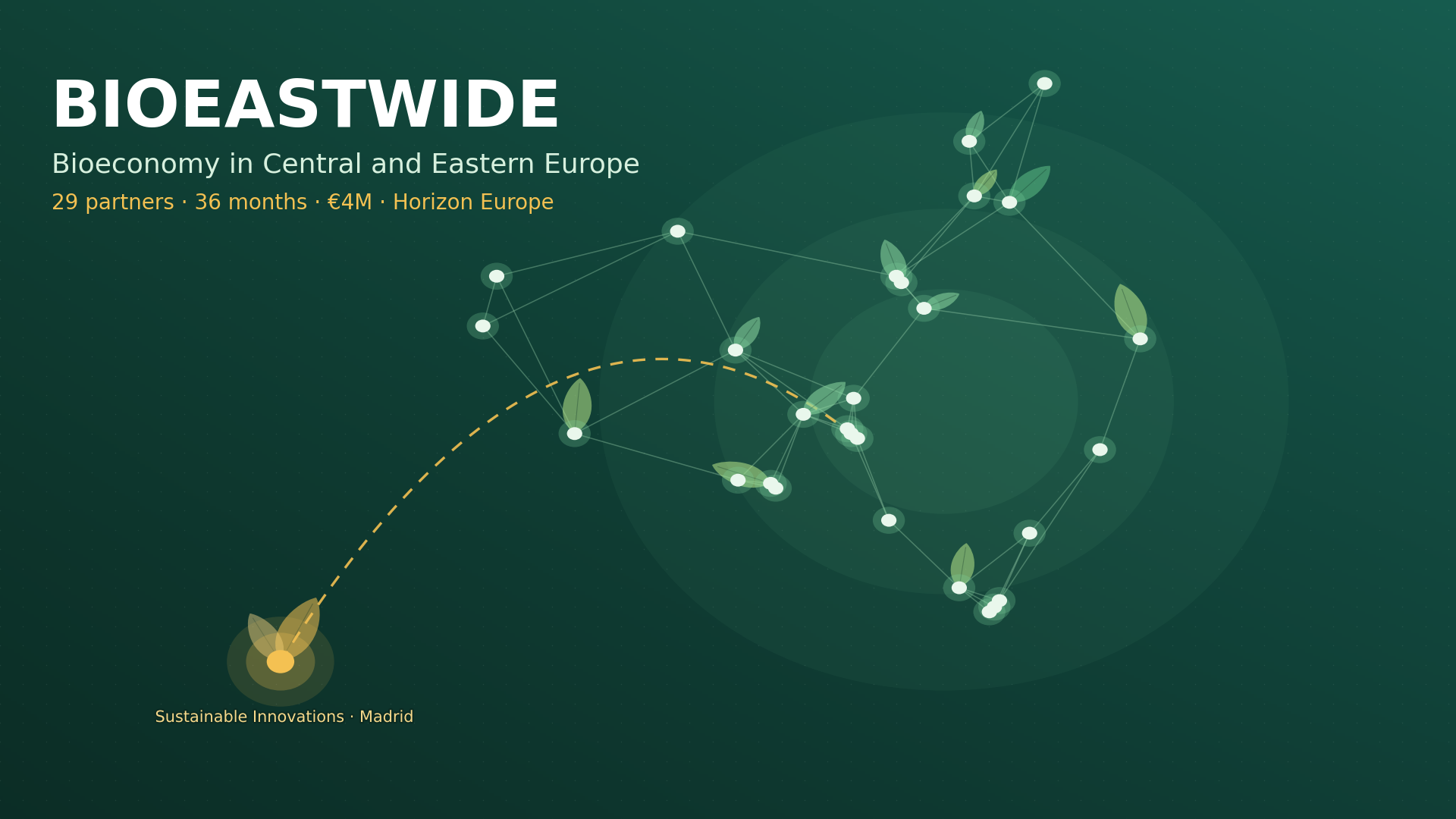
SUSTAINABLE INNOVATIONS to carry out the communication and dissemination of BIOEASTWIDE, a €4M Horizon Europe project to strengthen bioeconomy across Central and Eastern Europe

SUSTAINABLE INNOVATIONS will lead, for 36 months, the financial management, communication and exploitation tasks
SUSTAINABLE INNOVATIONS has been awarded 163,750 euros out of the 4 million total funding of the project
Madrid, September 29th. Sustainable Innovations (SIE) will be the leading partner for the financial management, communication and exploitation tasks within the BIOEASTWIDE project, a new Horizon Europe initiative aimed at advancing bioeconomy research and innovation (R&I) across Central and Eastern Europe, officially funded by the European Commission.
The project brings together a consortium of 29 partners from across Europe and neighboring regions to build a structured, long-term partnership that strengthens the bioeconomy ecosystem and enhances integration within the European Research Area (ERA).
With a total budget of 4 million euros, BIOEASTWIDE will support the development of a coordinated bioeconomy framework across the BIOEAST macro-region, including EU Member States and widening countries such as Ukraine, Moldova and the Western Balkans. Through mapping activities, strategic roadmap development and capacity-building programmes, the project will address key gaps in policy alignment, funding coordination and innovation uptake.
Sustainable Innovations participates in BIOEASTWIDE as a key partner, contributing to project management, communication, dissemination and stakeholder engagement, reinforcing its role as a facilitator of complex multi-stakeholder European initiatives. Building on its experience in projects such as BOOST4BIOEAST, SIE will support the consortium in ensuring effective coordination, visibility and impact of the project results.
In particular, SIE will play a central role in communication, dissemination and exploitation activities, ensuring that project outcomes reach relevant stakeholders across research, policy and industry, while fostering collaboration and knowledge exchange at European level.
“Participating in BIOEASTWIDE represents a new step in our commitment to strengthening the European bioeconomy ecosystem,” said Jesus Serrano, Deputy General Manager of Sustainable Innovations. “We are proud to contribute to a project that promotes collaboration, capacity building and long-term impact across Central and Eastern Europe.”
Over its 36-month duration, BIOEASTWIDE will mobilise ministries, funding agencies, research organisations, industry and civil society actors through dedicated networks such as BIOEAST HUBs and Thematic Working Groups. The project will ultimately contribute to improving governance frameworks, increasing participation of widening countries in EU programmes and accelerating the transition towards a sustainable and circular bioeconomy.
The challenges of bioeconomy in Central and Eastern European (CEE) countries
Central and Eastern European (CEE) countries participation in EU research programmes addressing bioeconomy continues to be low mostly due to lacking targeted research funding management and coordination at national levels, fragmented national and cross-border stakeholder collaboration, and poor R&I infrastructure that prevents the deployment at full scale of research results into practice. In parallel, the better involvement of EU accession countries such Ukraine, Moldova and Western Balkans into the ERA is foreseen, as they have untaped potential in terms of bioresources and human capital, but are facing very similar challenges as other EU CEE countries. But at the same time, these countries have particular geopolitical and local factors affecting their bioeconomy.
About BIOEASTWIDE
Led by the Agricultural University of Plovdiv (Bulgaria), the BIOEASTWIDE project is formed by the Institute of Soil Science and Plant Cultivation (Poland), ÖMKi: Research Institute of Organic Agriculture (Hungary), Budapest University of Technology and Economics (Hungary), National Research, Development and Innovation Office (Hungary), Ministry of Agriculture and Rural Development of the Slovak Republic (Slovakia), Circular Change (Slovenia), Ministry of Agriculture of the Republic of Lithuania, Latvia University of Life Sciences and Technologies, Estonian University of Life Sciences, Energy Institute Hrvoje Požar (Croatia), BIOEAST HUB CR (Czech Republic), Agricultural Academy (Bulgaria), Sustainable Innovations (Spain), Regional Bioeconomy Hub Plovdiv (Bulgaria), National Forest Centre (Slovakia), INOSTAR (Romania), Vytautas Magnus University (Lithuania), the Faculty of Agriculture of the University of Zagreb (Croatia), Institute of Rural and Agricultural Development, Polish Academy of Sciences (Poland), National University of Life and Environmental Sciences of Ukraine, BIOEAST Nexus (Belgium), University of Ljubljana (Slovenia), FiBL: Research Institute of Organic Agriculture (Switzerland), FNR: Agency for Renewable Resources (Germany), Climate-KIC (Netherlands), Association of Eco-Innovations of the Balkans (Serbia), National Centre for Research and Development (Poland), and the Academy of Economic Studies of Moldova.
The project has received €3,999,562.56 million in funding from the Horizon Europe research and innovation programme of the European Union under grant agreement number 101295859. On the other hand, SUSTAINABLE INNOVATIONS has received 163,750 euros.